

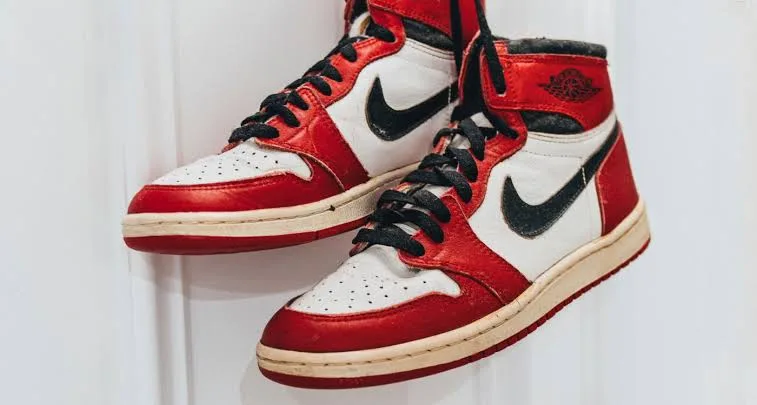
From Banned Sneaker to Global Icon: The True Story Behind the Air Jordan Phenomenon
Few sneakers carry as much cultural weight and financial impact as the Air Jordan 1. Its origin is directly linked to the history of professional basketball, a highly risky corporate gamble, and a ban that ultimately made the shoe more desirable than any conventional advertising campaign ever could.
1. A Rookie, a Gamble, and the Historic $2.5 Million Contract
In 1984, Nike was a distant third place in the basketball shoe market, lagging far behind Converse (which laced up Magic Johnson and Larry Bird) and Adidas. Signing a rookie out of the University of North Carolina named Michael Jordan was seen as a crazy move by marketing director Sonny Vaccaro and executive Phil Knight.
The final deal was worth $2.5 million over five years—an astronomical figure at the time that sparked public skepticism across sports media. Interestingly, Jordan actually preferred to sign with Adidas and only agreed to fly to Nike's headquarters in Oregon after his mother, Deloris Jordan, insisted he listen to their proposal. Nike's ultimate trump card was promising something unprecedented: a signature line bearing the player's name, thus birthing the Jordan Brand.
2. The Myth of the "Banned" Shoe and the $5,000 Marketing Stunt
The Air Jordan 1 in its classic "Bred" (Black and Red) colorway, commercially released in 1985, became legendary thanks to one of the most brilliant marketing narratives in history. The NBA enforced a strict uniform rule (the so-called 51% rule), which required players' footwear to be predominantly white and match the rest of the team.
- The Fine: The league sent a warning letter to Nike, establishing a $5,000-per-game fine every time Jordan wore the black and red model on court.
- The Strategy: Instead of backing down, Nike gladly paid the fines and turned the penalty into a historic TV commercial. The ad stated: "The NBA threw them out of the game, but they can't stop you from wearing them."
- The Historic Twist: Sneaker historians later discovered that the shoe actually banned by the NBA during the 1984 preseason games was the Nike Air Ship (a visually similar silhouette), as the Air Jordan 1 was still in development. Nike masterfully capitalized on this perfect timeline window to transfer that "rebel" reputation directly to the Jordan 1 when it hit retail shelves.
The payoff was instant: the sneaker became a badge of individuality and rebellion. Nike's initial goal was to hit $3 million in sales during the line's first three years; in the first year alone, revenue skyrocketed past $126 million.
3. From High Performance to Streetwear Royalty
Subsequent models in the lineup pushed the boundaries of athletic footwear technology and dictated visual trends under the genius of designer Tinker Hatfield:
- Air Jordan 3 (1988): Introduced the iconic Jumpman logo, Elephant Print, and visible Air cushioning, effectively saving the franchise at a time when Michael was considering leaving Nike.
- Air Jordan 6 (1991): Modeled with a silhouette inspired by Jordan's German sports cars, worn by him as he secured his very first NBA championship title with the Chicago Bulls.
- Air Jordan 11 (1995): Brought patent leather into the mix, transcending the hardwood courts to be styled alongside suits at award ceremonies.
The brand's enduring power came from something beyond pure performance. The re-releases known as "Retro," which kicked off in the late 1990s, introduced these historic models to a younger generation who had never seen Jordan play live. This transformed basketball shoes into timeless fashion statements.
4. The Screen Effect: The Impact of "The Last Dance" and "Air" on the Resell Market
Nostalgia and brand heritage were further fueled by major cinematic productions, sparking historic demand spikes and shifting the dynamics of the resale market:
- The Last Dance (2020): The release of the documentary series during pandemic lockdowns triggered a global frenzy. Classic models featured in the show—such as the Air Jordan 13 "Flint" and the Air Jordan 1 "Chicago" itself—saw overnight astronomical price surges on secondary platforms. Original vintage pairs and limited retro editions reached unprecedented price plateaus, attracting a new wave of investors and collectors to the sneaker landscape.
- Air (2023): The film directed by Ben Affleck brought a different, yet equally powerful effect. By detailing the behind-the-scenes negotiation with the Jordan family, the production reignited fascination for the Nike Air Ship and early 1985 Jordan 1 production runs. The movie solidified these models not just as urban fashion staples, but as cultural artifacts, sustaining strong value for re-releases featuring factory-distressed, vintage/aged looks.
5. A Billion-Dollar Empire and the Secondary Market
Today, Jordan Brand operates as a powerhouse division within Nike, pulling in billions of dollars in annual global revenue. Silhouettes from the line consistently lead data across major resale marketplaces, fueling historic collaborations with renowned artists (like Travis Scott), luxury fashion houses (like Dior), and cornerstone streetwear labels (like the late Virgil Abloh's Off-White).
What began as a dispute over uniform codes involving a rookie's footwear has evolved into the most valuable and influential sneaker franchise of all time. The history of the Air Jordan proves that cultural resonance and the right storytelling are marketing tools far more permanent than any conventional advertising layout.

Comments
Loading comments…
Log in to leave a comment